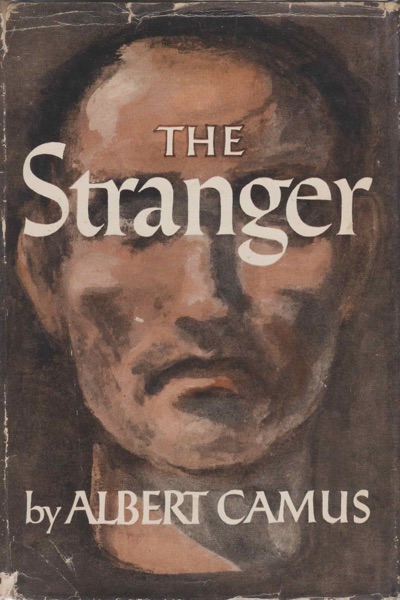
Estimated from the page count of this edition. Dense books can take longer than the estimate.
About the book
In postwar Amsterdam, Jean-Baptiste Clamence approaches a stranger in the Mexico City bar and begins recounting his former life as a successful Parisian lawyer. Once proud of defending worthy causes and helping others, he now calls himself a “judge-penitent,” examining the vanity and appetite for superiority beneath his public generosity. Their conversations continue over drinks and walks, with only Clamence’s side reaching us.
Reader notes
Polished, unsettling, and absorbed in questions of guilt, the short philosophical novel proceeds through recollection and argument rather than much outward action. Its conversational surface requires close attention to a speaker who keeps examining his own motives and other people’s claims to innocence. Suicide is a central subject.
How it reads
Writing style
Conversational · Dense · Essayistic · Witty
Tone
Cerebral · Dark · Intimate · Philosophical
Structure
Framed · Nonlinear
Driven by
Character · Ideas · Voice
Point of view
First person
Setting
Amsterdam · Paris
Reading complexity
Writing
4 / 5
Ideas
4 / 5
Structure
3 / 5
Background knowledge
2 / 5
About this profile
Collected’s assessment, not reader ratings. Complexity runs from 1 (least demanding) to 5 (most demanding).
Writing
How much attention the sentences and language require.
Ideas
How much interpretation or abstract reasoning the book asks of you.
Structure
How much you need to keep track of speakers, timelines and connections.
Background knowledge
Prior knowledge needed to follow the book, beyond what it explains.
Emotional intensity
Emotional pressure, from gentle (1) to intense (5). Separate from difficulty.
Themes
Guilt
Identity
Isolation
Knowledge and truth
Morality
Power
Content notes
Violence
Mild
Sexual content
Mild
Swearing
Mild
Substance use
Mild
Abuse
Mild
Self-harm or suicide
Strong
Standing and awards
Canonical
Everyman's Library
Widely translated and studied
Author: Nobel Prize in Literature, 1957
Questions readers ask
Is it hard to read?
Somewhat. The conversational voice carries dense, essayistic arguments, and Clamence’s repeated examination of his motives requires close attention. The difficulty comes from following his ideas and recollections rather than much outward action.
Does it have much of a plot?
Not really. Clamence recounts his former life through conversations over drinks and walks, with only his side reaching us. The measured pace follows recollection and argument rather than outward events.
What serious subjects should I be prepared for?
Suicide is a central subject and receives strong treatment. The unsettling tone also comes from Clamence’s sustained examination of guilt, his own motives, and other people’s claims to innocence.
What philosophical questions does it explore?
Guilt and morality take shape through a former lawyer’s examination of the vanity and desire for superiority beneath his public generosity. His account also questions other people’s claims to innocence.
How long is it?
147 pages in the Vintage Books 1963 mass market paperback edition.
Which edition is shown here?
Vintage Books · 1963 · Mass Market Paperback. ISBN 9780394702230.
How long does it take to read The Fall?
About 3 hours at 50 pages an hour, based on the 147-page Vintage Books edition. Dense books can take longer.
About the author
Albert Camus
Albert Camus was a French Algerian novelist, essayist, dramatist, journalist, and philosopher whose fiction and arguments repeatedly test how people live without reliable moral or metaphysical guarantees. His prose tends toward clarity and compression, though he changes form sharply: spare first-person narration, civic chronicle, philosophical essay, and sustained dramatic monologue. In The Stranger, Meursault’s flat account of death, murder, and trial leaves social judgment to gather around what he refuses to explain or perform. The Plague broadens the scale, moving among inhabitants of Oran as epidemic turns private choices into a record of collective suffering and practical responsibility. Camus’s essays state the underlying problem directly. The Myth of Sisyphus begins with the human demand for meaning and an unanswering universe, then argues for lucid persistence rather than escape. The Fall subjects such moral confidence to a darker method: a Parisian lawyer’s witty, circling confession becomes an accusation, with the silent listener gradually drawn into his habits of vanity and judgment.