Estimated from the page count of this edition. Dense books can take longer than the estimate.
About the book
Secluded in upstate New York, novelist Bill Gray endlessly revises a book he will not publish, his privacy guarded by his assistant Scott, who lives there with his lover Karen, a former Unification Church member. Photographer Brita Nilsson arrives to take Bill’s portrait, ending his refusal to be seen. An invitation to speak on behalf of a poet held hostage in Beirut draws him toward public life and political violence.
Reader notes
The literary novel is loosely plotted and frequently pauses for conversations about whether writers can still influence a culture dominated by televised terrorism. Its arguments matter as much as its action, so the hostage premise brings more discussion than thriller momentum.
How it reads
Writing style
Dense · Essayistic · Lyrical
Tone
Cerebral · Detached · Philosophical · Unsettling
Structure
Braided
Driven by
Argument · Character · Ideas
Point of view
Multiple viewpoints
Setting
Beirut, Lebanon
Reading complexity
Writing
4 / 5
Ideas
5 / 5
Structure
4 / 5
Background knowledge
2 / 5
About this profile
Collected’s assessment, not reader ratings. Complexity runs from 1 (least demanding) to 5 (most demanding).
Writing
How much attention the sentences and language require.
Ideas
How much interpretation or abstract reasoning the book asks of you.
Structure
How much you need to keep track of speakers, timelines and connections.
Background knowledge
Prior knowledge needed to follow the book, beyond what it explains.
Emotional intensity
Emotional pressure, from gentle (1) to intense (5). Separate from difficulty.
Themes
Art and creativity
Community
Identity
Isolation
Politics and ideology
Power
Content notes
Violence
Strong
Sexual content
Mild
Swearing
Mild
Substance use
Strong
Abuse
None
Self-harm or suicide
None
Standing and awards
Canonical
PEN/Faulkner Award, 1992
Pulitzer Prize for Fiction finalist, 1992
Library of America
PEN/Faulkner Award — PEN/Faulkner Award for Fiction, 1992
Questions readers ask
Is it hard to read?
Yes, the dense, essayistic prose and braided structure with multiple points of view require attention. Conversations about art, politics, and power frequently interrupt the action, making the arguments as important to follow as the characters’ movements.
Does the hostage story make it a thriller?
No, the hostage premise brings more discussion than thriller momentum. Bill Gray’s invitation to speak for a poet held hostage in Beirut draws him toward political violence, but the loosely plotted narrative moves at a measured pace.
What ideas does it explore?
A central question is whether novelists can still influence a culture dominated by televised terrorism. Bill’s seclusion, his refusal to publish, and his eventual encounter with a photographer also give concrete form to questions about creativity, privacy, identity, and public life.
What strong content should I expect?
Strong violence and substance use are the main concerns, with terrorism and a poet’s captivity central to the political storyline. Sexual content and strong language are mild.
How should I approach it?
Give the conversations about writers, terrorism, and cultural influence as much attention as the events. Following how those arguments connect with Bill’s isolation and tentative return to public life suits the novel’s emphasis on ideas and character.
How long is it?
256 pages in the Penguin Books 1992 paperback edition.
Which edition is shown here?
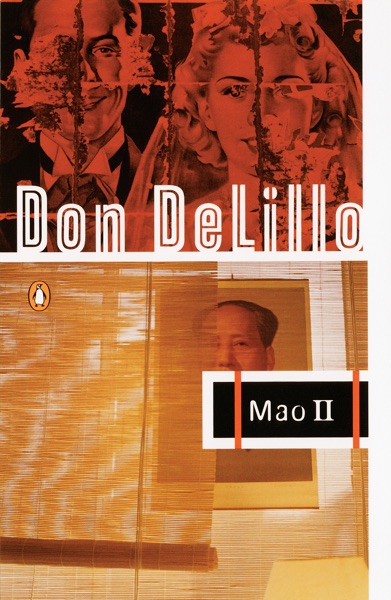
Penguin Books · 1992 · Paperback. ISBN 9780140152746.
How long does it take to read Mao II?
About 5 hours at 50 pages an hour, based on the 256-page Penguin Books edition. Dense books can take longer.
About the author
Don DeLillo
Don DeLillo is an American novelist, playwright, and essayist whose fiction examines how private consciousness is shaped by public systems: mass media, consumer culture, political violence, technology, and finance. His novels often place anxious or isolated figures inside large structures of information and power, then move between intimate speech and essayistic reflection. White Noise turns family life, academia, shopping, and televised catastrophe into dark comedy, while Libra approaches the Kennedy assassination through a collision of personal grievance, conspiracy, and the desire to enter history. In Mao II, the novelist’s public role competes with the power of crowds, images, and terrorism; Underworld broadens the method across Cold War history, sport, waste, and memory. DeLillo’s prose is characteristically dense and experimental, capable of quick shifts between abstraction and street-level idiom. Across works of very different scale, from the grief and bodily ritual of The Body Artist to the financial and technological enclosure of Cosmopolis, he returns to the unstable boundary between lived experience and the systems that represent, organize, or overwhelm it.