About 3 h 30 min · at 30 minutes a day, about 8 days
Estimated from the page count of this edition. Dense books can take longer than the estimate.
About the book
Stranded on an isolated Pacific island, Edward Prendick becomes dependent on Dr Moreau and his assistant Montgomery for shelter and any prospect of escape. Moreau has continued the animal experiments that disgraced him in England, surgically reshaping animals into humanlike creatures. These Beast Folk live under rules enforced through pain, while Prendick tries to understand their lives and the authority of the men who control them.
Reader notes
Told through Prendick's frightened first-person narration, the novel combines science fiction and horror. Its disturbing material includes sustained animal cruelty and abuse; the experiments raise questions about scientific responsibility and what separates humans from other animals.
How it reads
Writing style
Atmospheric · Descriptive · Direct
Tone
Dark · Philosophical · Tense · Unsettling
Structure
Framed · Linear
Driven by
Atmosphere · Character · Ideas
Point of view
First person
Setting
Dr. Moreau's island · Southern Pacific Ocean
Reading complexity
Writing
3 / 5
Ideas
4 / 5
Structure
2 / 5
Background knowledge
1 / 5
About this profile
Collected’s assessment, not reader ratings. Complexity runs from 1 (least demanding) to 5 (most demanding).
Writing
How much attention the sentences and language require.
Ideas
How much interpretation or abstract reasoning the book asks of you.
Structure
How much you need to keep track of speakers, timelines and connections.
Background knowledge
Prior knowledge needed to follow the book, beyond what it explains.
Emotional intensity
Emotional pressure, from gentle (1) to intense (5). Separate from difficulty.
Themes
Identity
Knowledge and truth
Morality
Nature and environment
Power
Trauma
Content notes
Violence
Strong
Sexual content
None
Swearing
Mild
Substance use
Strong
Abuse
Strong
Self-harm or suicide
Mild
Standing and awards
Canonical
Penguin Classics
Widely translated and studied
Questions readers ask
Is it hard to read?
Not really. The prose is direct and descriptive, the pace is brisk, and Prendick’s first-person account follows a largely linear path within a frame. The greater challenge is the disturbing material and the questions it raises about science and morality.
Is it more science fiction or horror?
Science fiction supplies the experiments; horror shapes the experience of them. Animals are surgically reshaped into humanlike creatures, while Prendick’s frightened narration and dependence on Moreau create a tense, unsettling atmosphere on the isolated island.
How disturbing is the animal cruelty?
Sustained animal cruelty and abuse are central, with strong violence involving surgical experiments and rules enforced through pain. The suffering is tied directly to Moreau’s control over the Beast Folk, making it part of the novel’s central concerns.
What philosophical questions does it explore?
The experiments raise questions about scientific responsibility and what separates humans from other animals. Moreau’s authority over the Beast Folk also connects those questions to power and morality: their lives are governed by rules enforced through pain.
How long is it?
176 pages in the Penguin Classics 2005 paperback edition.
Which edition is shown here?
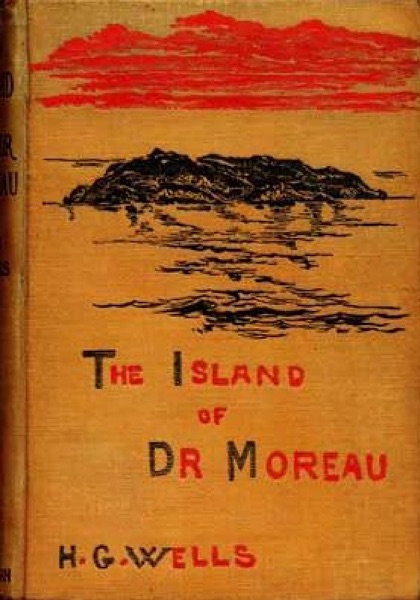
Penguin Classics · 2005 · Paperback. ISBN 9780141441023.
How long does it take to read The Island of Dr Moreau?
About 3 hours 30 minutes at 50 pages an hour, based on the 176-page Penguin Classics edition. Dense books can take longer.
About the author
H. G. Wells
H. G. Wells was an English writer whose unusually broad career encompassed fiction, history, politics, popular science, satire, biography, and social commentary. He is now chiefly remembered as a formative writer of science fiction, but the speculative device in his work is rarely an end in itself. Time travel, invisibility, alien invasion, engineered creatures, and flight to the Moon become practical ways of testing social arrangements, scientific responsibility, human confidence, and the uses of power. Wells often begins with a sharply legible premise, then develops it through direct, descriptive storytelling that draws on adventure, horror, allegory, or satire as the subject requires. The Time Machine and When the Sleeper Wakes turn distant futures into critiques of class and political order, while The Island of Dr. Moreau and The Invisible Man examine experimenters whose technical command outstrips their judgment. This combination of conceptual clarity, narrative momentum, and sustained social argument helped make Wells central to the development of modern science fiction and also reflects the forward-looking public critic he was in his own lifetime.