Estimated from the page count of this edition. Dense books can take longer than the estimate.
About the book
Returning from lunch carrying a paperback and a bag of new shoelaces, Howie approaches the escalator to his mezzanine office. The puzzle of why both his old laces broke within a day sends his thoughts through childhood memories, office bathroom etiquette and the design of ordinary objects, from plastic straws to paper towel dispensers. His lunchtime reading of Marcus Aurelius becomes another reference point in his examination of daily life.
Reader notes
Funny and minutely observant, the novel follows Howie’s associations through elaborate first-person sentences and long, digressive footnotes. There is almost no conventional plot: the pleasure, and possible obstacle, is how long he can spend considering something most people barely notice.
How it reads
Writing style
Dense · Essayistic · Stream of consciousness · Witty
Tone
Cerebral · Humorous · Playful · Reflective
Structure
Fragmented
Driven by
Character · Ideas · Voice
Point of view
First person
Setting
Workplace
Reading complexity
Writing
4 / 5
Ideas
3 / 5
Structure
4 / 5
Background knowledge
1 / 5
About this profile
Collected’s assessment, not reader ratings. Complexity runs from 1 (least demanding) to 5 (most demanding).
Writing
How much attention the sentences and language require.
Ideas
How much interpretation or abstract reasoning the book asks of you.
Structure
How much you need to keep track of speakers, timelines and connections.
Background knowledge
Prior knowledge needed to follow the book, beyond what it explains.
Emotional intensity
Emotional pressure, from gentle (1) to intense (5). Separate from difficulty.
Themes
Knowledge and truth
Memory
Technology and society
Work
Content notes
Violence
None
Sexual content
Mild
Swearing
None
Substance use
None
Abuse
None
Self-harm or suicide
None
Questions readers ask
Is it hard to read?
Somewhat. Elaborate first-person sentences and long, digressive footnotes demand attention, even when Howie is considering something as ordinary as shoelaces. The challenge lies in following his associations and sustained scrutiny of small details.
Is there much of a plot?
No. There is almost no conventional plot: Howie’s return from lunch opens into thoughts about childhood, office bathroom etiquette and everyday objects. The movement comes from his associations rather than a sequence of events.
Who is it best suited to?
It suits someone who enjoys witty, essayistic fiction and close attention to ordinary life. Howie can spend a long time examining plastic straws or paper towel dispensers; that minute observation is both the appeal and the possible obstacle.
How long is it?
About 135 pages in the Vintage Books 1990 edition. The measured pace and long, digressive footnotes give those pages more density than the length might suggest.
Which edition is shown here?
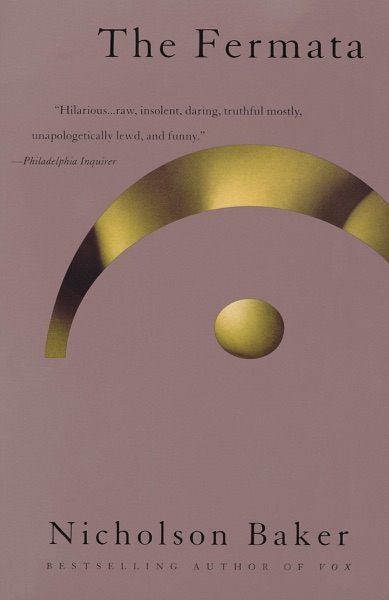
Grove Press · 2010 · Paperback. ISBN 9780802144904.
How long does it take to read The Mezzanine?
About 3 hours at 50 pages an hour, based on the 144-page Grove Press edition. Dense books can take longer.
About the author
Nicholson Baker
Nicholson Baker is an American novelist and essayist whose work ranges from microscopic studies of consciousness to erotic fantasy and documentary history. He often reduces outward action so that attention itself becomes the organizing force. Objects, bodily habits, memories, and stray facts generate digressions, while unusual structures expose how narrators arrange or excuse their own thoughts. In The Mezzanine, an escalator ride back from lunch expands through long footnotes and chains of association into an inquiry about shoelaces, straws, hand dryers, and other overlooked designs. His interest in desire can take a more troubling form. The Fermata gives its secretive protagonist the power to stop time, then lets his confessional narration reveal the evasions with which he defends invasions of women’s privacy. Baker’s nonfiction applies the same concern with arrangement to public records. Human Smoke builds its account of the origins of World War II from chronologically ordered speeches, reports, and transcripts, using limited commentary and close juxtaposition rather than a continuous retrospective argument.