About 6 h 30 min · at 30 minutes a day, about 13 days
Estimated from the page count of this edition. Dense books can take longer than the estimate.
About the book
Arno Strine, a thirty-five-year-old office temp in Boston, can stop time while remaining free to move himself. During these pauses, he undresses and touches women without their knowledge, restoring their clothes before ordinary life resumes. In the autobiography he calls The Fermata, he explains his power, recounts the sexual stories he leaves for women to discover, and defends his actions as harmless.
Reader notes
The narration is precise, talkative and digressive, lingering over ordinary objects before launching into extended, graphically explicit sexual fantasies. The comic manner accompanies repeated nonconsensual sexual touching, and much of the reading involves listening to Arno justify conduct the women cannot perceive or refuse.
How it reads
Writing style
Essayistic · Witty
Tone
Intimate · Irreverent · Unsettling
Structure
Episodic
Driven by
Character · Voice
Point of view
First person
Setting
Boston
Reading complexity
Writing
4 / 5
Ideas
3 / 5
Structure
3 / 5
Background knowledge
1 / 5
About this profile
Collected’s assessment, not reader ratings. Complexity runs from 1 (least demanding) to 5 (most demanding).
Writing
How much attention the sentences and language require.
Ideas
How much interpretation or abstract reasoning the book asks of you.
Structure
How much you need to keep track of speakers, timelines and connections.
Background knowledge
Prior knowledge needed to follow the book, beyond what it explains.
Emotional intensity
Emotional pressure, from gentle (1) to intense (5). Separate from difficulty.
Themes
Morality
Power
Sexuality
Content notes
Violence
Mild
Sexual content
Strong
Swearing
Strong
Substance use
None
Abuse
Strong
Self-harm or suicide
None
Questions readers ask
What sexual content should I expect?
Strong sexual content includes extended, graphically explicit fantasies and repeated nonconsensual sexual touching. Arno undresses and touches women while time is stopped, then restores their clothes; much of his narration defends actions they cannot perceive or refuse.
Is it hard to read?
Somewhat. The precise, essayistic narration is talkative and digressive, lingering over ordinary objects before moving into extended sexual fantasies. The reading effort comes from following Arno’s voice and justifications through a measured, episodic narrative.
Is the time-stopping premise the main attraction?
The time-stopping power supplies the premise, but the emphasis is on character and voice. Arno’s first-person autobiography explores power, sexuality and morality through his accounts of what he does during the pauses and how he justifies it.
What kind of humor does it have?
The humor is dark, witty and irreverent, with an intimate, unsettling tone. The comic manner accompanies Arno’s repeated nonconsensual touching and his insistence that his actions are harmless.
How long is it?
320 pages in the Vintage 1995 paperback edition.
Which edition is shown here?
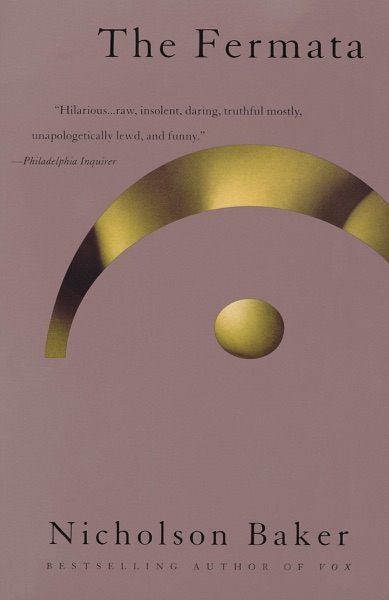
Vintage · 1995 · Paperback. ISBN 9780679759331.
How long does it take to read The Fermata?
About 6 hours 30 minutes at 50 pages an hour, based on the 320-page Vintage edition. Dense books can take longer.
About the author
Nicholson Baker
Nicholson Baker is an American novelist and essayist whose work ranges from microscopic studies of consciousness to erotic fantasy and documentary history. He often reduces outward action so that attention itself becomes the organizing force. Objects, bodily habits, memories, and stray facts generate digressions, while unusual structures expose how narrators arrange or excuse their own thoughts. In The Mezzanine, an escalator ride back from lunch expands through long footnotes and chains of association into an inquiry about shoelaces, straws, hand dryers, and other overlooked designs. His interest in desire can take a more troubling form. The Fermata gives its secretive protagonist the power to stop time, then lets his confessional narration reveal the evasions with which he defends invasions of women’s privacy. Baker’s nonfiction applies the same concern with arrangement to public records. Human Smoke builds its account of the origins of World War II from chronologically ordered speeches, reports, and transcripts, using limited commentary and close juxtaposition rather than a continuous retrospective argument.