
Do I need to read the earlier books first?
Yes, start with Ender's Shadow, the preceding novel in the Shadow Series. Returning characters and conflicts build on it, and Shadow of the Hegemon is the second entry in that series.
 collected
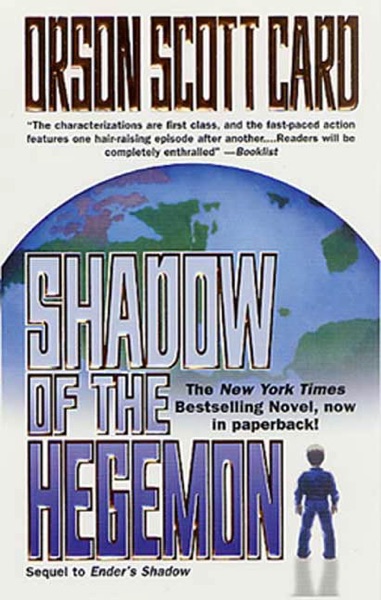
Fiction · Novel · Science Fiction · Political Fiction
About 9 h · at 30 minutes a day, about 19 days
Estimated from the page count of this edition. Dense books can take longer than the estimate.
In the second Shadow Series novel, humanity's victory over the alien Formics leaves a future Earth free to resume its national rivalries. The children trained to command humanity's fleets return home as military assets worth kidnapping. Bean escapes the seizure of his fellow strategists and seeks help from Peter Wiggin, Ender's older brother, whose influence behind the scenes has grown into ambitions to unite the planet under his rule.
The science fiction becomes an Earthbound political thriller, full of strategic conversations, competing ambitions, and arguments over power. It can be talk-heavy, and its returning characters and conflicts build on Ender's Shadow, the preceding novel. Captivity and psychological abuse are serious parts of the story.
Collected’s assessment, not reader ratings. Complexity runs from 1 (least demanding) to 5 (most demanding).
Yes, start with Ender's Shadow, the preceding novel in the Shadow Series. Returning characters and conflicts build on it, and Shadow of the Hegemon is the second entry in that series.
Earth politics drives the story after humanity's victory over the Formics. The returning child commanders become targets for kidnapping, while Bean seeks Peter Wiggin's help amid national rivalries and ambitions to unite the planet under one ruler.
The prose is direct and dialogue driven, but the strategic conversations and competing political ambitions demand attention. A linear story and brisk pace help, though the arguments over power can make stretches feel talk-heavy.
Strong abuse, particularly captivity and psychological abuse, is a serious part of the story. The kidnapping of the returning child strategists makes coercion central to the political struggle; violence itself is mild.
About 451 pages in the Tor 2001 edition. The pace is brisk, though strategic conversations and arguments over power can make stretches feel talk-heavy.
Tor · 2001 · Mass Market Paperback. ISBN 9780812565959.
About 9 hours at 50 pages an hour, based on the 451-page Tor edition. Dense books can take longer.
Orson Scott Card is an American novelist, essayist, and columnist best known for science fiction that gives character and moral choice more weight than technological exposition. His direct, accessible prose often moves through dialogue, contests, and escalating problems, with exceptionally gifted characters forced to reason under pressure. Ender's Game provides the clearest model: military training is organized as a sequence of games and zero-gravity battles whose brisk progression conceals the true consequences of Ender Wiggin's decisions. Card also revisits events from altered viewpoints. Ender's Shadow retells that conflict through Bean, turning a familiar plot into an investigation of intelligence, survival, and the institutions that exploit talented children. In Speaker for the Dead, the pace broadens and the method becomes more discursive as Ender reconstructs a dead man's life amid family secrecy, ecological danger, and restricted contact with an alien species. Such settings let Card return to responsibility, political power, communication across profound difference, and the contested boundaries of personhood.


The catalog does not yet include a matching edition. Details may differ between editions.