About 9 h 15 min · at 30 minutes a day, about 19 days
Estimated from the page count of this edition. Dense books can take longer than the estimate.
About the book
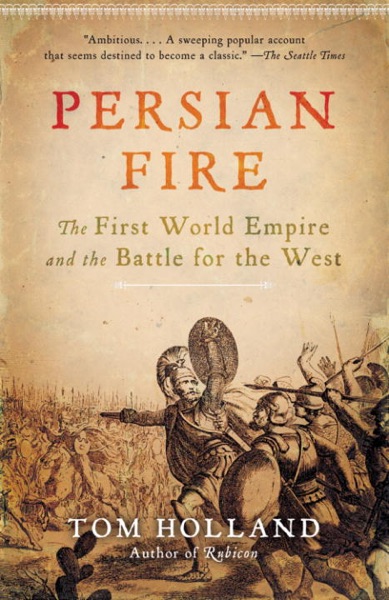
Tom Holland traces the Persian Empire’s expansion under Cyrus, Darius and Xerxes and its wars against the Greek city-states in the early fifth century BCE. Athens’s developing democracy and Sparta’s militarized society receive attention alongside the empire they opposed, placing Marathon, Thermopylae and Salamis within a wider history of rival political systems and ambitions. Drawing heavily on Herodotus, Holland connects the conflict to later ideas about a divide between East and West.
Reader notes
Brisk and dramatic, the narrative combines vivid, often bloody battle scenes with explanations of how both societies worked. It ranges well beyond military history, spending time on rulers, institutions and cultural background before the armies meet.
How it reads
Writing style
Descriptive · Journalistic
Tone
Atmospheric · Cerebral · Earnest · Tense
Structure
Chronological nonfiction
Driven by
Ideas · Information
Setting
Persian Empire · Greece
Evidence style
Research synthesis
Practical orientation
Reflective
Nonfiction form
History · Narrative nonfiction
Reading complexity
Writing
3 / 5
Ideas
3 / 5
Structure
3 / 5
Background knowledge
2 / 5
About this profile
Collected’s assessment, not reader ratings. Complexity runs from 1 (least demanding) to 5 (most demanding).
Writing
How much attention the sentences and language require.
Ideas
How much interpretation or abstract reasoning the book asks of you.
Structure
How much you need to keep track of speakers, timelines and connections.
Background knowledge
Prior knowledge needed to follow the book, beyond what it explains.
Emotional intensity
Emotional pressure, from gentle (1) to intense (5). Separate from difficulty.
Themes
Colonialism and empire
Freedom
Power
War
Content notes
Violence
Strong
Sexual content
Mild
Swearing
None
Substance use
None
Abuse
Mild
Self-harm or suicide
None
Questions readers ask
Do I need to know ancient history before starting?
No, little prior knowledge is needed. The chronological narrative explains rulers, institutions and cultural background alongside the Persian expansion and the Greek city-states, though the competing political systems and ambitions require some attention.
Is it mainly about battles?
No, it spends substantial time on how the Persian Empire, Athens and Sparta worked before the armies meet. Marathon, Thermopylae and Salamis sit within a wider account of rulers, institutions, culture and rival political ambitions.
Does it read like an academic history or a dramatic narrative?
The narrative is brisk and dramatic, with descriptive, journalistic prose and vivid battle scenes. It combines research synthesis with explanations of societies and political ideas, drawing heavily on Herodotus.
How graphic is the violence?
Strong violence appears in vivid, often bloody battle scenes. The fighting receives dramatic treatment alongside explanations of the societies involved, so the account includes both military violence and broader political and cultural history.
How long is it?
About 464 pages in the Anchor 2007 edition.
Which edition is shown here?
Anchor · 2007 · Paperback. ISBN 9780307279484.
How long does it take to read Persian Fire?
About 9 hours 15 minutes at 50 pages an hour, based on the 464-page Anchor edition. Dense books can take longer.
About the author
Tom Holland
Tom Holland is a British novelist and popular historian whose work ranges from Gothic fiction to large-scale histories of the ancient and religious worlds. He writes history as a sequence of decisions made under pressure, using character, political rivalry, military conflict, and sharply staged scenes to carry broad explanations. Rubicon turns the Roman Republic’s collapse into a fast-moving account of ambition and civil war, while Dynasty follows the imperial system through households where succession, appetite, and government become entangled. His wider histories shift from narrative momentum to sustained argument. In Dominion, he traces Christian assumptions through Western moral thought, showing how ideas now treated as secular acquired their authority over centuries. In the Shadow of the Sword reconstructs late antiquity around Islam’s emergence and repeatedly tests origin stories against fragmentary evidence. Holland’s scale is expansive, but his structures remain legible: empires and belief systems are approached through crises, contested sources, and the people who tried to command them. His translation of Herodotus also reflects his continuing engagement with ancient narrative.