Writing style
Descriptive · Direct · Journalistic
 Apple Books
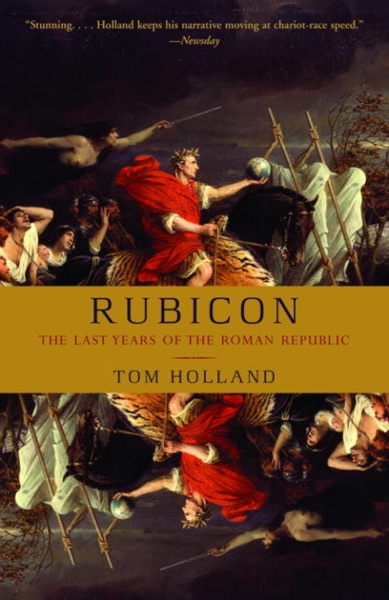
Tom Holland recounts the violent transformation of Rome from republic to empire through the ambitions, rivalries, and political crises of its final republican generation. At the center stands Julius Caesar’s crossing of the Rubicon in 49 B.C., the act that drives Rome into civil war and makes the survival of its political order uncertain. The narrative places Caesar among figures including Cicero, Spartacus, Brutus, Cleopatra, Virgil, and Augustus, showing how personal advancement, military power, intrigue, and public ideals collided during decades of upheaval. Rather than treating the Republic’s fall as an abstract institutional change, Holland presents it as a human struggle shaped by calculated risks and catastrophic choices. Rubicon offers a broad narrative of warfare and decadence while asking how a society suspicious of kings came to accept imperial rule.
Collected’s assessment, not reader ratings. Complexity runs from 1 (least demanding) to 5 (most demanding).
Descriptive · Direct · Journalistic
Brisk
Cerebral · Dark · Tense
Chronological nonfiction
Character · Ideas · Plot
4 / 5
History of Rome · Book 1
For the print edition listed above.
Apple Books is a service mark of Apple Inc. iPhone is a trademark of Apple Inc., registered in the U.S. and other countries.