About 3 h 30 min · at 30 minutes a day, about 8 days
Estimated from the page count of this edition. Dense books can take longer than the estimate.
About the book
Journalist Janet Malcolm examines what reporters owe their subjects through the dispute between Joe McGinniss and Jeffrey MacDonald, convicted of murdering his wife and daughters. MacDonald cooperated with McGinniss believing his book, Fatal Vision, would support his innocence; its portrayal of him prompted a lawsuit for fraud and breach of contract. Drawing on interviews and trial testimony, Malcolm asks how the trust cultivated during reporting squares with a writer's freedom to tell an independent story.
Reader notes
Spare and unsparing, the book combines legal reporting with an argument about journalism's moral compromises. Malcolm includes her own encounters with the participants, putting her methods under scrutiny too. The reading concerns the making of a crime narrative more than the investigation of the murders.
How it reads
Writing style
Essayistic
Tone
Cerebral · Philosophical
Structure
Argumentative
Driven by
Argument
Point of view
First person
Setting
Courtroom
Evidence style
Journalistic reporting
Practical orientation
Reflective
Nonfiction form
Argument criticism · Narrative nonfiction
Reading complexity
Writing
3 / 5
Ideas
4 / 5
Structure
3 / 5
Background knowledge
2 / 5
About this profile
Collected’s assessment, not reader ratings. Complexity runs from 1 (least demanding) to 5 (most demanding).
Writing
How much attention the sentences and language require.
Ideas
How much interpretation or abstract reasoning the book asks of you.
Structure
How much you need to keep track of speakers, timelines and connections.
Background knowledge
Prior knowledge needed to follow the book, beyond what it explains.
Emotional intensity
Emotional pressure, from gentle (1) to intense (5). Separate from difficulty.
Themes
Knowledge and truth
Morality
Work
Content notes
Violence
Mild
Sexual content
None
Swearing
Mild
Substance use
None
Abuse
None
Self-harm or suicide
None
Standing and awards
Canonical
Modern Library 100 Best Nonfiction
Questions readers ask
Is it hard to read?
Somewhat. The challenge lies in the argument about journalism’s moral compromises, with essayistic prose and a measured pace. Malcolm asks how a reporter’s cultivation of trust can coexist with the freedom to tell an independent story.
Is it mainly an investigation of the murders?
No. The focus is on how a crime narrative gets made, through the dispute between Joe McGinniss and Jeffrey MacDonald. Interviews and trial testimony support an examination of reporting, trust and a subject’s expectations.
Does Malcolm examine her own reporting methods?
Yes. Malcolm includes her own encounters with the participants, putting her methods under scrutiny alongside McGinniss’s. That first-person involvement makes the ethical argument extend to her own work as a journalist.
Is it a practical guide to journalism?
No. Its orientation is reflective: legal reporting becomes the basis for an argument about what reporters owe their subjects. It suits an interest in journalism’s ethics and the making of crime narratives.
How long is it?
176 pages in the Vintage 1990 paperback edition.
Which edition is shown here?
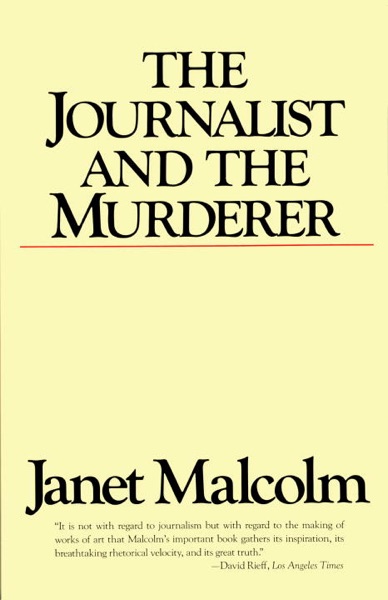
Vintage · 1990 · Paperback. ISBN 9780679731832.
How long does it take to read The Journalist and the Murderer?
About 3 hours 30 minutes at 50 pages an hour, based on the 176-page Vintage edition. Dense books can take longer.
About the author
Janet Malcolm
Janet Malcolm was a staff writer at The New Yorker whose literary nonfiction examined the unstable compact between observer and subject, often through the lens of psychoanalysis. Her prose attends closely to clothing, speech, furniture, and other surfaces that disclose character and social role. She built arguments from interviews, case histories, and disputed motives, moving between sharply observed scenes and exacting analysis. Psychoanalysis: The Impossible Profession follows a pseudonymous analyst and draws on careful study of technical literature. The Journalist and the Murderer uses the relationship between reporter Joe McGinniss and accused murderer Jeffrey MacDonald to investigate trust, private assurances, and the shaping demands of narrative.