Writing style
Descriptive · Essayistic · Lyrical
 Apple Books
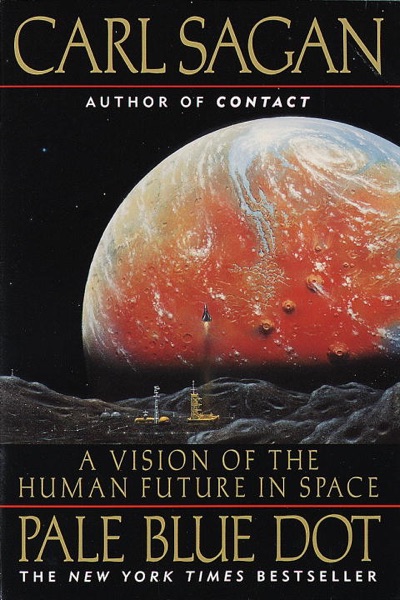
Carl Sagan uses the image of Earth as a distant point in space to reconsider humanity’s place in the universe. Moving between the history of geocentric belief and the discoveries of the Voyager mission, he examines why cultures have treated Earth and humankind as uniquely central. His tour of planets and moons asks where life might exist, what other worlds can teach us about protecting our own, and whether humanity can responsibly extend its habitation beyond Earth. The argument also confronts cosmic hazards and the political choices required for long-term survival, including space colonization and terraforming. Blending scientific explanation with civic reflection, the book presents exploration not as an escape from Earth but as a way to understand its fragility and shared significance.
Collected’s assessment, not reader ratings. Complexity runs from 1 (least demanding) to 5 (most demanding).
Descriptive · Essayistic · Lyrical
Measured
Atmospheric · Cerebral · Earnest · Philosophical
Argumentative
Argument · Ideas · Information
3 / 5
For the print edition listed above.
Apple Books is a service mark of Apple Inc. iPhone is a trademark of Apple Inc., registered in the U.S. and other countries.