
Is it hard to read?
No, the conversational prose, brisk pace and episodic structure make it accessible. Sightseeing and eating episodes alternate with historical background and social commentary, without requiring prior knowledge of China.
 collected
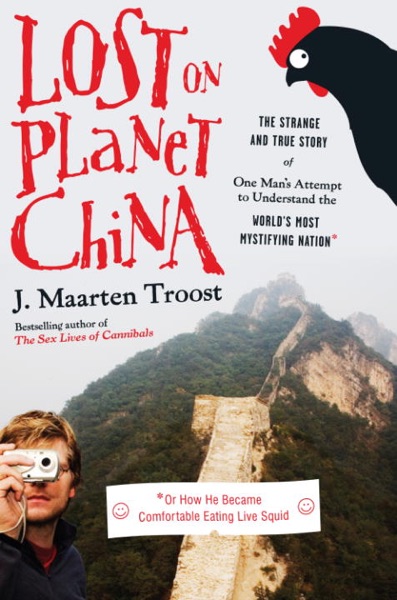
Nonfiction · Biography & Memoir · Travel
About 7 h 45 min · at 30 minutes a day, about 16 days
Estimated from the page count of this edition. Dense books can take longer than the estimate.
J. Maarten Troost travels through China to consider whether he could live there with his wife and children. Unable to speak the language, he navigates crowded cities and unfamiliar menus, visits Mao's preserved body and joins the crowds climbing Tai Shan. His journey takes in Beijing and Shanghai, while encounters with smog and chaotic traffic accompany observations about Chinese history, the economic boom, political controls and widening inequalities.
The travelogue is irreverent and personal, its humor rooted in Troost's bewilderment and practical mishaps. Episodes of sightseeing and eating alternate with historical background and social commentary; his impressions as a visitor remain the organizing perspective.
Collected’s assessment, not reader ratings. Complexity runs from 1 (least demanding) to 5 (most demanding).
No, the conversational prose, brisk pace and episodic structure make it accessible. Sightseeing and eating episodes alternate with historical background and social commentary, without requiring prior knowledge of China.
Not really, its emphasis is personal reflection rather than practical guidance. Troost’s difficulties with language, unfamiliar menus and chaotic traffic supply anecdotes and observations rather than instructions for planning a visit.
The humor is irreverent and rooted in Troost’s bewilderment and practical mishaps. His experiences of crowded cities, sightseeing and eating sit alongside more reflective observations about history, political controls and inequality.
Troost writes as a visitor considering whether he could live in China with his wife and children. His first-person impressions organize the account, with personal experience providing the basis for historical and social observations.
382 pages in the Broadway 2008 hardcover edition.
Broadway · 2008 · Hardcover. ISBN 9780767922005.
About 7 hours 45 minutes at 50 pages an hour, based on the 382-page Broadway edition. Dense books can take longer.
J. Maarten Troost is a Dutch-American travel writer and essayist whose books turn prolonged encounters with unfamiliar places into conversational narrative nonfiction. He usually makes his own confusion and physical discomfort part of the evidence, moving from comic mishap to descriptive observation and then to questions of history, politics, or cultural misunderstanding. In The Sex Lives of Cannibals, two years on Tarawa supply a tight domestic frame for scenes of heat, scarce food, failed utilities, and bureaucratic absurdity, while also opening onto the Battle of Tarawa and ill-fitting foreign aid. Lost on Planet China adopts a wider, more mobile structure. Its crowded cities, remote regions, meals, and transit problems register a country whose scale and rapid change defeat easy summary. The later Headhunters on My Doorstep complicates Troost’s established method. Following Robert Louis Stevenson through the South Pacific, he retains the logistical comedy of travel but folds it into a sober account of addiction, family, and the limits of escape.



The catalog does not yet include a matching edition. Details may differ between editions.