About 9 h 15 min · at 30 minutes a day, about 19 days
Estimated from the page count of this edition. Dense books can take longer than the estimate.
About the book
Erik Larson follows the construction of Chicago’s 1893 World’s Columbian Exposition alongside the crimes of H. H. Holmes, a doctor and swindler operating nearby. Architect Daniel Burnham and his collaborators, including landscape architect Frederick Law Olmsted, race to create the fair’s buildings and grounds under severe financial and time pressure. Meanwhile, Holmes builds a hotel and draws young women into his control, exploiting the opportunities of a rapidly growing city.
Reader notes
The narrative history reads like a novel, alternating the public drama of construction with an increasingly disturbing story of manipulation and murder. Architectural planning receives as much attention as true crime, so the fair’s practical problems occupy long stretches between Holmes’s appearances.
How it reads
Writing style
Atmospheric · Descriptive · Journalistic
Tone
Atmospheric · Dark · Suspenseful · Tense
Structure
Braided · Chronological nonfiction
Driven by
Atmosphere · Character · Plot
Point of view
Third person, omniscient
Setting
Chicago
Evidence style
Archival history · Research synthesis
Nonfiction form
History · Narrative nonfiction
Reading complexity
Writing
3 / 5
Ideas
3 / 5
Structure
3 / 5
Background knowledge
1 / 5
About this profile
Collected’s assessment, not reader ratings. Complexity runs from 1 (least demanding) to 5 (most demanding).
Writing
How much attention the sentences and language require.
Ideas
How much interpretation or abstract reasoning the book asks of you.
Structure
How much you need to keep track of speakers, timelines and connections.
Background knowledge
Prior knowledge needed to follow the book, beyond what it explains.
Emotional intensity
Emotional pressure, from gentle (1) to intense (5). Separate from difficulty.
Themes
Ambition
Crime and punishment
Gender
Power
Wealth
Work
Content notes
Violence
Strong
Sexual content
Mild
Swearing
Mild
Substance use
Mild
Abuse
Mild
Self-harm or suicide
Mild
Standing and awards
Highly regarded
Edgar Award, 2004
National Book Award finalist, 2003
Questions readers ask
Is it more about the fair or the murders?
Architectural planning receives as much attention as true crime. Long stretches follow Daniel Burnham and his collaborators as they tackle the fair’s buildings, grounds, finances and deadlines between appearances by Holmes.
Is it hard to read?
Not really, though the alternating storylines require some attention. The journalistic prose and novel-like narrative make the history approachable without prior knowledge, while descriptive passages and extended accounts of architectural planning keep the pace moderate.
How disturbing is it?
Strong violence and an increasingly disturbing account of manipulation and murder are central to Holmes’s storyline. His control of young women unfolds alongside the public drama of building the fair, giving the alternating narrative a dark, tense atmosphere.
Does it read like a novel or a history?
It reads like a novel while drawing on archival history and research synthesis. The chronological narrative braids the pressure of constructing the exposition with Holmes’s crimes, using atmosphere, character and suspense to carry the history.
How long is it?
About 464 pages in the Vintage Books 2004 edition. The pace is moderate, with long stretches devoted to the fair’s practical problems between Holmes’s appearances.
Which edition is shown here?
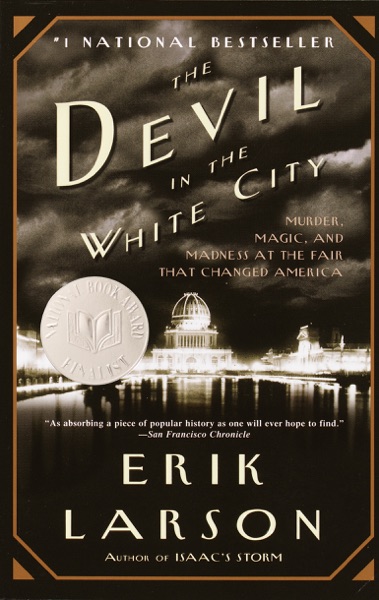
Vintage Books · 2004 · Paperback. ISBN 9780375725609.
How long does it take to read The Devil in the White City?
About 9 hours 15 minutes at 50 pages an hour, based on the 464-page Vintage Books edition. Dense books can take longer.
About the author
Erik Larson
Erik Larson is an American journalist and author whose career has centered on historical nonfiction shaped with the momentum of narrative. A former features writer for The Wall Street Journal and Time, he brings a reporter’s attention to telling detail and a novelist’s control of pace without leaving the documentary record behind. His books draw on archival research and primary sources, often arranging separate lives or lines of action so that they converge around a crisis. The Devil in the White City pairs civic ambition with concealed violence at the 1893 Chicago world’s fair, while Thunderstruck links the rise of wireless communication to a transatlantic murder case. In the Garden of Beasts, Dead Wake, and The Splendid and the Vile approach political upheaval and wartime catastrophe through people caught inside unfolding events. Larson’s characteristic subject is history before its outcome feels inevitable. He combines large public forces with intimate experience, using atmosphere, character, and suspense to make familiar episodes newly immediate.