About 6 h 45 min · at 30 minutes a day, about 14 days
Estimated from the page count of this edition. Dense books can take longer than the estimate.
About the book
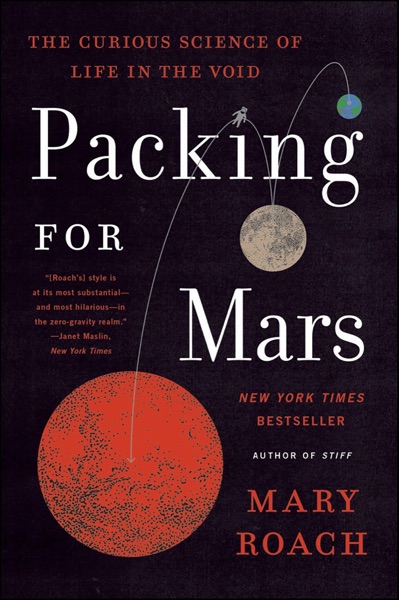
Mary Roach investigates what it takes to keep a human body functioning in space, where eating, sleeping, washing and using a toilet become engineering problems. Visiting researchers and interviewing astronauts, she examines astronaut selection, motion sickness, prolonged bed rest and the practical questions surrounding sex in space. She also takes a weightless flight and investigates the use of cadavers in capsule crash tests.
Reader notes
The popular-science reporting is frank and frequently scatological, punctuated by Roach’s firsthand mishaps and digressive footnotes. Despite the title, much of the book concerns experiments on Earth and past missions to the Moon and space stations, with Mars as the longer-term challenge.
How it reads
Writing style
Conversational · Journalistic · Witty
Tone
Humorous · Irreverent
Structure
Episodic
Driven by
Information · Voice
Point of view
First person
Setting
Earth
Evidence style
Journalistic reporting · Personal experience · Scientific studies
Practical orientation
Reflective
Nonfiction form
Investigative reporting · Popular science
Reading complexity
Writing
2 / 5
Ideas
3 / 5
Structure
2 / 5
Background knowledge
1 / 5
About this profile
Collected’s assessment, not reader ratings. Complexity runs from 1 (least demanding) to 5 (most demanding).
Writing
How much attention the sentences and language require.
Ideas
How much interpretation or abstract reasoning the book asks of you.
Structure
How much you need to keep track of speakers, timelines and connections.
Background knowledge
Prior knowledge needed to follow the book, beyond what it explains.
Emotional intensity
Emotional pressure, from gentle (1) to intense (5). Separate from difficulty.
Themes
Survival
Technology and society
Content notes
Violence
Mild
Sexual content
Mild
Swearing
Mild
Substance use
Mild
Abuse
Mild
Self-harm or suicide
Mild
Questions readers ask
Do I need a science background?
No, the conversational reporting requires little prior knowledge. Roach explains the problems of keeping humans functioning in space through researcher visits, astronaut interviews and her own experiences, with witty prose and digressive footnotes.
Is it mainly about going to Mars?
No, much of the reporting concerns experiments on Earth and past missions to the Moon and space stations. Mars provides the longer-term challenge, while the immediate focus is how bodies cope with space travel.
How much bathroom and bodily detail is there?
Frank, frequently scatological reporting makes eating, washing and using a toilet central engineering questions. Roach also investigates motion sickness, sex in space and cadavers in capsule crash tests; sexual content and violence are mild.
Does it tell a continuous story?
The reporting is episodic and brisk, moving among investigations into astronaut selection, prolonged bed rest and other problems of human spaceflight. Roach’s firsthand mishaps and digressive footnotes give the science a humorous, irreverent tone.
Is it a practical guide to space travel?
Not really, it is investigative popular science focused on understanding how human spaceflight works. Interviews, scientific studies and Roach’s own weightless flight explore bodily limits and engineering problems rather than provide step-by-step instructions.
How long is it?
336 pages in the W. W. Norton & Company 2011 paperback edition.
Which edition is shown here?
W. W. Norton & Company · 2011 · Paperback. ISBN 9780393339918.
How long does it take to read Packing for Mars?
About 6 hours 45 minutes at 50 pages an hour, based on the 336-page W. W. Norton & Company edition. Dense books can take longer.
About the author
Mary Roach
Mary Roach is an American writer who brings popular science into contact with the physical, awkward, and often overlooked facts of human life. Her books range across death, sex, digestion, spaceflight, military physiology, and attempts to study survival after death, but they share a recognizable method: she follows practical questions into laboratories and other unusual research settings, interviews specialists, examines scientific studies, and sometimes places herself inside the inquiry. Stiff considers what donated cadavers make possible; Packing for Mars and Grunt turn away from heroic technology to the bodily strains of extreme environments. In Bonk and Gulp, subjects commonly treated with embarrassment become occasions for precise, curious reporting. Roach’s humor makes difficult or impolite material approachable without displacing the science. What distinguishes her writing is its preference for the unglamorous problem and the revealing detail: the space toilet, the living stomach, the mechanics of arousal, or the experimental uses of the dead. Her books explain science by showing how research is devised, conducted, and limited.