Is it hard to read?
Yes, the dense, spare prose and compact instructions give it a formal, methodical rhythm. Verse and comparisons between earlier teachers’ opinions and Vatsyayana’s own add to the reading effort.
 collected
Nonfiction · Reference · Philosophy · Social Science
About 4 h 45 min · at 30 minutes a day, about 10 days
Estimated from the page count of this edition. Dense books can take longer than the estimate.
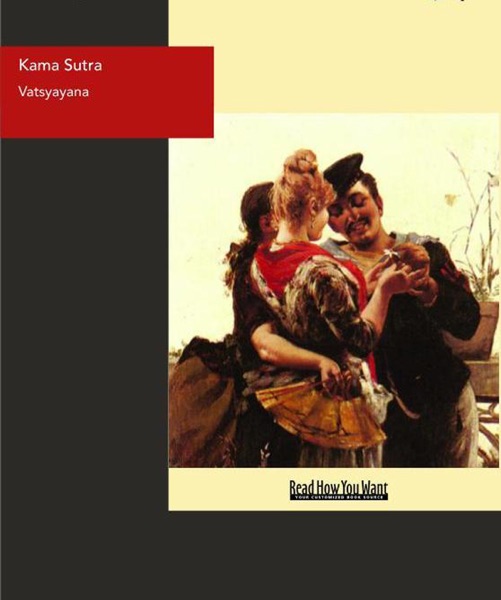
Kama Sutra is an ancient Indian treatise on pleasure and relationships, addressed chiefly to the educated man maintaining a household in the city. Vatsyayana treats desire as a legitimate part of life whose pursuit requires social skills as well as sexual knowledge. Its seven parts cover courtship, choosing a spouse, married life, sexual techniques, courtesans, affairs with married women, and preparations intended to increase attraction.
Compact instructions and verse give the writing a formal, methodical rhythm, with earlier teachers’ opinions often set beside Vatsyayana’s own. Sexual advice is explicit, and the prescriptions assume sharply unequal standing for men and women, making the book a record of historical attitudes as well as a guide to pleasure.
Collected’s assessment, not reader ratings. Complexity runs from 1 (least demanding) to 5 (most demanding).
Canonical
Yes, the dense, spare prose and compact instructions give it a formal, methodical rhythm. Verse and comparisons between earlier teachers’ opinions and Vatsyayana’s own add to the reading effort.
No, sexual techniques sit within a wider discussion of pleasure and relationships. Its seven parts also cover courtship, choosing a spouse, married life, courtesans, affairs with married women, and preparations intended to increase attraction.
Strong sexual content includes explicit sexual advice. The prescriptions also assume sharply unequal standing for men and women, making gender inequality central to the attitudes expressed about pleasure and relationships.
The advice chiefly addresses an educated man maintaining a household in the city. Its prescriptions combine sexual knowledge with social skills, treating desire as a legitimate part of life.
240 pages in the Modern Library 2002 paperback edition.
Modern Library · 2002 · Paperback. ISBN 9780375759246.
About 4 hours 45 minutes at 50 pages an hour, based on the 240-page Modern Library edition. Dense books can take longer.
Vatsyāyana was an ancient Indian philosopher, the author named in the Kama Sutra. Little is known about his life; scholars usually place him in the early centuries CE, often around the third century, possibly in Pataliputra. In the Kama Sutra he treats desire as one of the aims of a well-lived life, alongside dharma and artha, rather than as an isolated subject. Writing for a cultivated urban society and drawing on earlier teachers such as Babhravya, he applies a systematic, comparative approach to courtship, marriage, intimacy and social conduct. His attention to regional customs and to gender, class and power makes the work both a practical treatise and an account of its social world.