About 10 h 30 min · at 30 minutes a day, about 21 days
Estimated from the page count of this edition. Dense books can take longer than the estimate.
About the book
Technology journalist Steven Levy traces the rise of computer culture from MIT’s Tech Model Railroad Club in the late 1950s to California’s home-computer movement and early game-software businesses. Programmers seeking time on university machines lead into the Homebrew Computer Club, Steve Wozniak’s hardware experiments and Bill Gates’s arguments for selling software. Across these communities, Levy follows a recurring conflict between the hacker ethic of freely shared information and the commercial rewards of owning what you create.
Reader notes
Reported scenes, conversations and detailed portraits carry the chronological history. The tone is openly admiring of the hackers’ ingenuity and obsessive commitment; computing appears as a consuming way of life, as much as a technical pursuit.
How it reads
Writing style
Journalistic
Tone
Earnest · Reflective
Structure
Chronological nonfiction
Driven by
Character · Ideas
Setting
Cambridge, Massachusetts (MIT) · Northern California
Evidence style
Journalistic reporting
Practical orientation
Reflective
Nonfiction form
History · Narrative nonfiction
Reading complexity
Writing
3 / 5
Ideas
3 / 5
Structure
2 / 5
Background knowledge
1 / 5
About this profile
Collected’s assessment, not reader ratings. Complexity runs from 1 (least demanding) to 5 (most demanding).
Writing
How much attention the sentences and language require.
Ideas
How much interpretation or abstract reasoning the book asks of you.
Structure
How much you need to keep track of speakers, timelines and connections.
Background knowledge
Prior knowledge needed to follow the book, beyond what it explains.
Emotional intensity
Emotional pressure, from gentle (1) to intense (5). Separate from difficulty.
Themes
Community
Freedom
Technology and society
Work
Content notes
Violence
None
Sexual content
Mild
Swearing
Mild
Substance use
Mild
Abuse
None
Self-harm or suicide
Mild
Standing and awards
Established
Widely read and recognized
Questions readers ask
Do I need a technical background to follow it?
No, little prior computing knowledge is needed. Levy carries the history through reported scenes, conversations and portraits of the people involved, following a chronological path from university computing to home computers and early game-software businesses.
Is it a practical guide to computing?
No, it is a narrative history with a reflective focus. University programmers, the Homebrew Computer Club and early software businesses provide the setting for questions about community, ownership and computing as a consuming vocation.
What ideas does it explore?
The central tension is between freely sharing information and earning commercial rewards from what you create. Levy follows that conflict through hacker communities, Steve Wozniak’s hardware experiments and Bill Gates’s arguments for selling software.
Does it take a critical view of hacker culture?
Not really, the tone is openly admiring of the hackers’ ingenuity and obsessive commitment. The history explores tensions around sharing and ownership while portraying computing as a consuming way of life.
How long is it?
About 520 pages in the O'Reilly Media 2010 edition. The chronological history moves at a moderate pace, carried by reported scenes, conversations and detailed portraits.
Which edition is shown here?
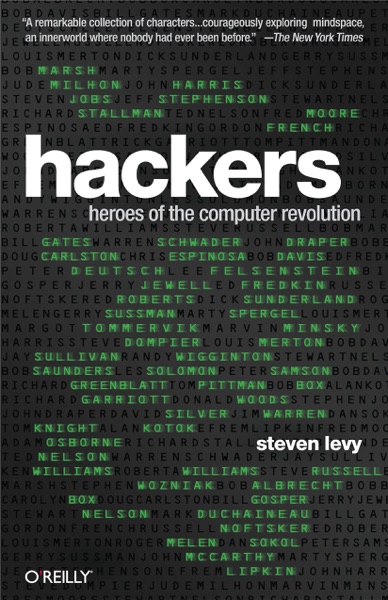
O'Reilly Media · 2010 · Paperback. ISBN 9781449388393.
How long does it take to read Hackers?
About 10 hours 30 minutes at 50 pages an hour, based on the 520-page O'Reilly Media edition. Dense books can take longer.
About the author
Steven Levy
Steven Levy is an American journalist and editor at large for Wired whose career has centered on the people, institutions, and ideas shaping digital technology. His books combine narrative history, investigative reporting, interviews, and close access to organizations, making technical developments understandable through the choices and convictions of their creators. Hackers grew from an early magazine assignment into an account of the communities that formed around computers and the ethic of open information and hands-on experimentation. In Crypto, Levy traced the development of modern cryptography alongside disputes over privacy and control. His reporting on companies including Apple, Google, and Facebook extends the same approach to powerful technology businesses, drawing on sustained access and extensive interviews. Across this work, Levy is especially attentive to the way technical ideals become cultures, products, and institutions, and to the tensions that arise when openness, commercial ambition, security, and privacy meet.