About 10 h 30 min · at 30 minutes a day, about 22 days
Estimated from the page count of this edition. Dense books can take longer than the estimate.
About the book
Evolutionary biologist Jared Diamond asks why some societies acquired the means to conquer others, tracing the answer through 13,000 years of human history. He argues that geography and access to domesticable plants and animals, rather than inherited differences between peoples, shaped these inequalities. Comparing developments across continents, he connects farming and food surpluses to specialized labor, writing, weapons, and the epidemic diseases that devastated populations encountering conquerors.
Reader notes
Detailed explanations of crops, livestock, and disease make this a sustained work of popular science and world history. The argument repeatedly returns to the links between agriculture and conquest, so its broad scope comes with some repetition.
How it reads
Writing style
Dense · Direct · Essayistic
Tone
Cerebral · Detached · Earnest
Structure
Argumentative
Driven by
Argument · Ideas · Information
Setting
Eurasia and North Africa · Papua New Guinea
Evidence style
Case studies · Research synthesis
Practical orientation
Theoretical
Nonfiction form
Explanation synthesis · History · Popular science
Reading complexity
Writing
3 / 5
Ideas
4 / 5
Structure
4 / 5
Background knowledge
2 / 5
About this profile
Collected’s assessment, not reader ratings. Complexity runs from 1 (least demanding) to 5 (most demanding).
Writing
How much attention the sentences and language require.
Ideas
How much interpretation or abstract reasoning the book asks of you.
Structure
How much you need to keep track of speakers, timelines and connections.
Background knowledge
Prior knowledge needed to follow the book, beyond what it explains.
Emotional intensity
Emotional pressure, from gentle (1) to intense (5). Separate from difficulty.
Themes
Colonialism and empire
Inequality
Knowledge and truth
Nature and environment
Power
Technology and society
Content notes
Violence
Mild
Sexual content
None
Swearing
Mild
Substance use
None
Abuse
Mild
Self-harm or suicide
None
Standing and awards
Canonical
Pulitzer Prize for General Nonfiction, 1998
Royal Society Science Book Prize, 1998
Pulitzer Prize — Pulitzer Prize for General Nonfiction, 1998
Questions readers ask
Is it hard to read?
Somewhat. Dense, direct prose and detailed explanations of crops, livestock, and disease require sustained attention. The difficulty comes from following a broad argument across continents and connecting agriculture, technology, disease, and conquest.
What is the main argument?
Diamond argues that geography and access to domesticable plants and animals shaped inequalities between societies, rather than inherited differences between peoples. He connects farming and food surpluses to specialized labor, writing, weapons, and epidemic disease.
Who is it best suited to?
It suits someone looking for a theoretical explanation of large historical patterns through popular science and world history. Case studies and research synthesis support an argument about inequality and conquest, rather than practical guidance.
Does it move quickly?
No. The pace is measured, with extended explanations of agriculture and disease. The argument repeatedly returns to the connections between farming and conquest, so the broad historical scope comes with some repetition.
How long is it?
About 528 pages in the W. W. Norton & Company 2017 edition. Detailed explanations and a measured pace make it a sustained read.
Which edition is shown here?
W. W. Norton & Company · 2017 · paperback. ISBN 9780393354324.
How long does it take to read Guns, Germs, and Steel?
About 10 hours 30 minutes at 50 pages an hour, based on the 528-page W. W. Norton & Company edition. Dense books can take longer.
About the author
Jared Diamond
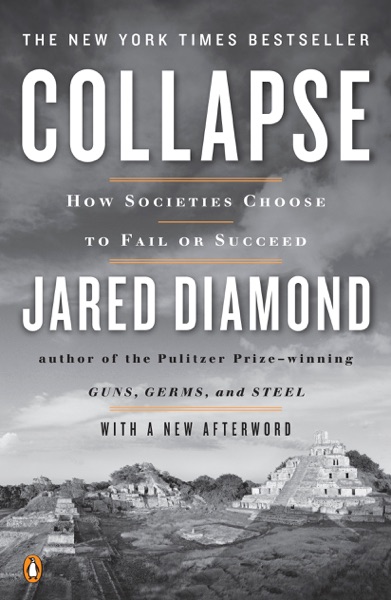
Jared Diamond is an American scientist, historian, and author whose popular nonfiction brings biology, ecology, geography, anthropology, and political history into large comparative arguments. Originally trained in biochemistry and physiology, he typically begins with a broad question, assembles evidence from multiple disciplines, and tests an explanatory framework against sharply different societies. Guns, Germs, and Steel traces global inequalities through the uneven distribution of domesticable species, continental geography, disease resistance, and the institutions supported by agricultural surplus. Collapse uses archaeological and modern case studies to examine how environmental damage, climate, trade, conflict, and collective decisions interact. In The World Until Yesterday, Diamond turns the same comparative method toward everyday practices such as child-rearing, dispute settlement, elder care, and risk. His prose is direct and densely explanatory, moving from concrete examples to long causal sequences. The breadth that makes these syntheses accessible has also drawn criticism from anthropologists who argue that he gives geography and climate too much explanatory weight.